





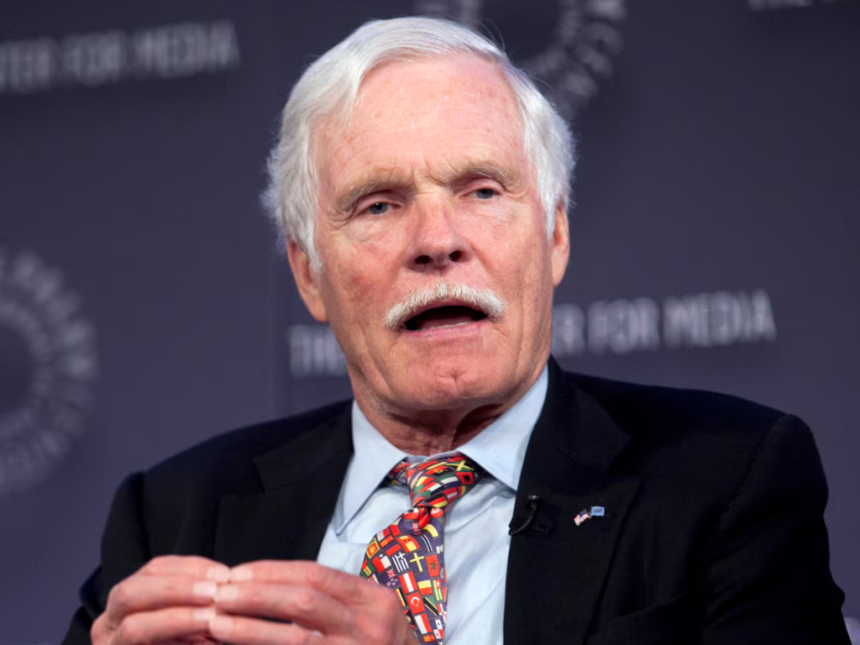
Ted Turner Dead At 87: Beyond CNN, He Quietly Tried to Save the Planet
Ted Turner, CNN founder and media mogul, passed away on Wednesday at the age of 87. Beyond his broadcasting empire, Turner leaves behind one of the most remarkable private conservation legacies in American history spanning 3,125 square miles of ranchland across six states, the world’s largest bison herd, and the recovery of some of North America’s rarest species.
It all began with a ten-year-old boy reading National Geographic. When Turner read about bison nearly going extinct, he made a promise to himself. Decades later after building his fortune he bought his first bison in 1976 and his first ranch in 1987, and never stopped.
“I want to inspire people to care about the environment. When we connect with nature, we heal ourselves. When we protect nature, we heal the planet.”— Ted Turner, 2016
Across 13 ranches, Turner replaced cattle with bison, restored overgrazed land, brought back grey wolves, cleaned up streams and ran captive breeding programmes for species on the edge including the black-footed ferret, one of the rarest mammals on Earth, and the Bolson tortoise, North America’s largest and rarest tortoise.
He called himself a caretaker, not an owner. He called his approach “eco-capitalism” the belief that conservation and business could not only coexist but strengthen each other. His bison supplied steaks to Ted’s Montana Grill restaurants across 14 states, helping spread bison ranching nationwide and dramatically improving the species’ gene pool.
What the people who knew his work say
Tom Johnson, former president of CNN who worked closely with Turner for years, spoke about what drove the man beyond the television studios.
“He wanted part of America to still be preserved and in some way protected as it was at the time that the American Indians roamed those lands. In this era of development and commercialisation and bad zoning, he cleaned up the streams and brought back the gray wolves and the prairie dog. He really cared about nature and was seeing what was happening.”— Tom Johnson, former CNN President
Jennifer Morris, CEO of The Nature Conservancy, offered a pointed summary of what set Turner apart from others who simply talked about conservation.
“He invested in land, restored ecosystems, and showed what’s possible when you pair vision with real commitment. His work helped redefine conservation, proving that private lands and private capital can be powerful forces for public good.”— Jennifer Morris, CEO, The Nature Conservancy
Turner’s conservation work was not universally celebrated. When he shifted from cattle to bison on his western ranches and began supporting wolf reintroduction programmes including a Mexican wolf breeding programme at the Ladder Ranch in New Mexico ranching organisations pushed back hard, citing concerns about wolves killing livestock.
In Argentina, where Turner purchased large tracts during the privatisation wave of the 1990s and 2000s, his land acquisitions initially drew nationalist sentiment and suspicion. Over time, however, his focus on low-impact ecotourism and conservation drew far less criticism than that of other foreign buyers.
Ted Turner is gone. But the wolves are still running at the Ladder Ranch. The bison still move across the Flying D. The black-footed ferrets are still being counted at Vermejo. And the Bolson tortoises are still being bred at Armendaris slowly, steadily, one generation at a time.