


Human, Not AI: Viral Meme in The Devil Wears Prada 2 Surprises Audiences
A brief moment in The Devil Wears Prada 2 has sparked an unexpected conversation about art, authenticity, and the growing confusion around artificial intelligence. What many viewers initially dismissed as AI-generated “slop” has turned out to be the work of a real human artist.
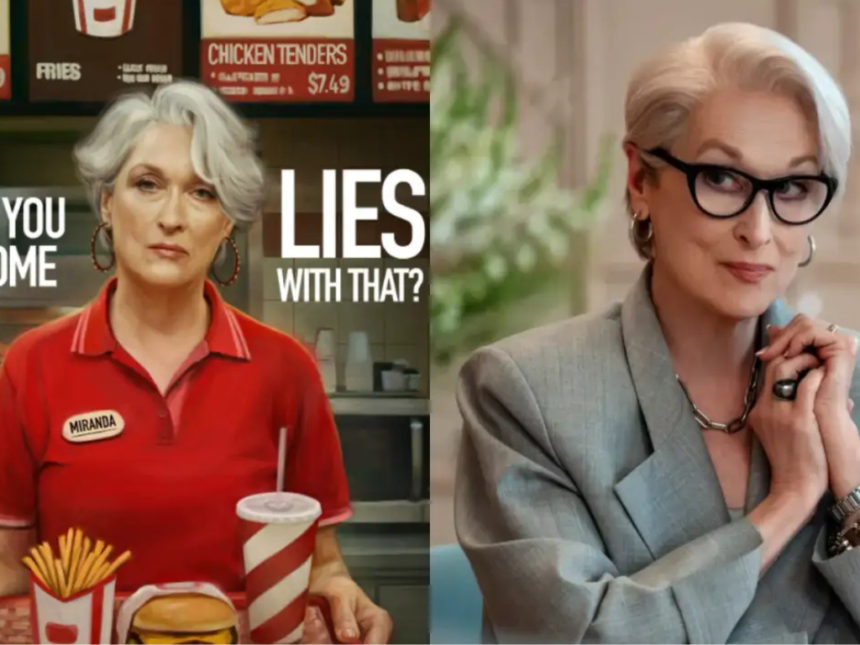
The highly anticipated sequel to The Devil Wears Prada has drawn major attention at the box office, reuniting its iconic cast and revisiting the world of the fictional fashion magazine Runway two decades later. In one scene, a series of internet memes mock the formidable editor-in-chief Miranda Priestley, played once again by Meryl Streep. Among them is a blink-and-you-miss-it image of Priestley depicted as a fast-food worker with the caption, “Would you like some lies with that?”
The meme’s deliberately rough, overly processed look led many viewers to assume it was intentionally designed to resemble AI-generated content—a satirical nod to the current state of digital media. However, that assumption quickly unraveled when illustrator Alexis Franklin revealed that she had personally created the artwork by hand.

Sharing her process on Instagram, including a time-lapse video, Franklin explained that the piece was commissioned by director David Frankel. “It was nothing but fun,” she wrote, adding that the digital painting took several days of intermittent work and that she was fairly compensated.
Franklin intentionally aimed for a “cheap, plastic” aesthetic inspired by early 2010s meme culture, which ironically contributed to the confusion. Elements like blurred text—often seen as a hallmark of AI-generated images—led some viewers to believe she was mimicking AI. Franklin clarified that while she wanted the image to look artificial, imitating AI was never her goal.
Despite sharing clear proof of her process and having an established portfolio, Franklin has still faced skepticism, with some accusing her of falsely claiming authorship. The reaction highlights a growing issue in the digital age: as AI tools become more advanced, people are increasingly misidentifying both AI-generated and human-made content.
Franklin described this as a kind of “hypervigilance,” where audiences are so wary of being deceived that they begin to see signs of AI where none exist. While she understands the intent—many people want to support human artists—she also warns that this skepticism can inadvertently harm them.
“AI is so prevalent now, it feels like people have forgotten how it got that good—it studied us,” she noted, emphasizing that the foundations of AI-generated art are rooted in human creativity.
The incident serves as a striking example of the blurred lines between human and machine-made art. In an era where AI continues to reshape creative industries, even authentic human work is no longer immune to doubt.