




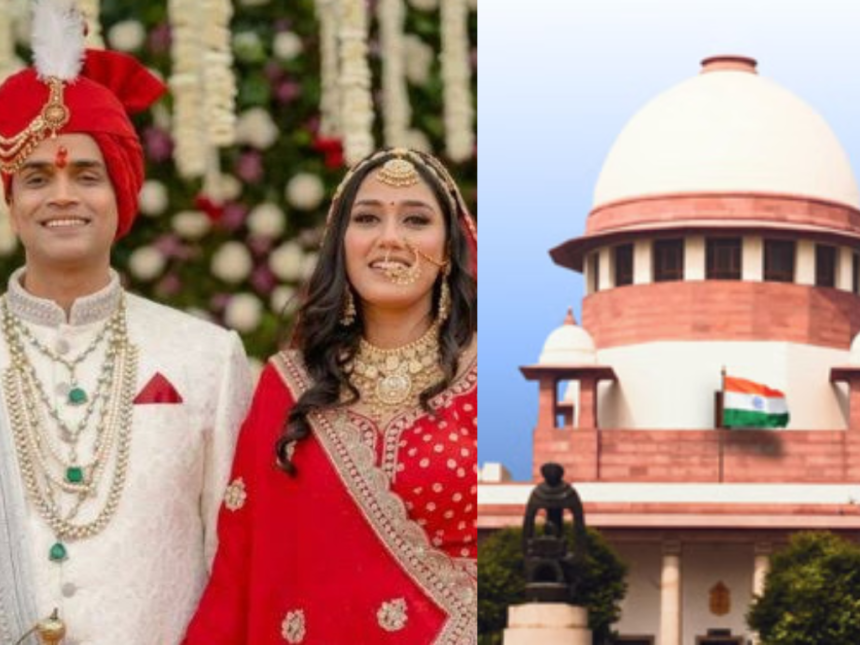
The Supreme Court on Monday made significant observations in the Twisha Sharma death case, asking both families involved to avoid speaking to the media while the investigation is in progress. Calling the matter “sensitive” and “unfortunate,” the court stressed that public narratives and emotional television debates should not interfere with the legal process.
Twisha Sharma, a 33-year-old former actor and model, was found hanging at her matrimonial home in Bhopal’s Katara Hills area on May 12. While the incident was initially treated as a suicide, the case soon took a dramatic turn after Twisha’s family accused her husband, Samarth Singh, and mother-in-law, Giribala Singh, of dowry harassment and mental torture.
The case quickly became a national talking point not only because of the serious allegations but also because Giribala Singh is a former district judge. Twisha’s family alleged that there were procedural irregularities and possible institutional bias during the early stages of the investigation. These allegations led the Supreme Court to take suo motu cognisance of the matter and later transfer the investigation to the Central Bureau of Investigation (CBI).
During Monday’s hearing, the bench led by Chief Justice Surya Kant said it was “slightly in pain” seeing how both sides were continuously presenting their versions through media interviews. The court stated that statements being made publicly could create unnecessary impressions about the outcome of issues that are still under investigation.
The bench observed that both families should cooperate with investigators instead of participating in media discussions that may influence public opinion. The judges emphasized that facts must emerge through proper legal procedure and not through emotional television debates or social media campaigns.
The Supreme Court also addressed the growing narrative surrounding the judiciary because the accused’s mother is a former judge. The bench clearly said it was against the idea that the judiciary was attempting to derail the investigation or protect anyone involved in the case.
“The mother-in-law is a former district judge, and it is unfortunate that it is being said the judiciary is derailing the trial. We are against the narrative that is being created,” the court remarked during the hearing.
The lawyer representing the Singh family assured the court that Giribala Singh would not make further public statements regarding the investigation.
At the center of the case is a marriage that reportedly began with hope but soon became troubled. Twisha Sharma, originally from Noida, had met Samarth Singh through a dating app in 2024. The two got married in December 2025 and settled in Bhopal.
According to Twisha’s family and close friends, she had been emotionally distressed after marriage and often spoke about feeling trapped and unhappy. Her family alleged that she was repeatedly humiliated and pressured over dowry-related issues.
The Singh family has strongly denied these accusations. They claimed that Twisha was suffering from depression and alleged that she consumed narcotics. Giribala Singh had earlier described some of Twisha’s actions as “theatrics,” a statement that triggered criticism online and added more controversy to the case.
After Twisha’s death, tensions escalated when her family refused to accept her body and demanded a second post-mortem examination, claiming the initial probe was inadequate. Her body remained at AIIMS Bhopal until a second autopsy was conducted by a team from AIIMS Delhi.
Meanwhile, Samarth Singh, who had remained untraceable after the incident, was arrested last week after appearing before a court in Jabalpur to surrender. He had earlier withdrawn his anticipatory bail plea from the Madhya Pradesh High Court.
During the hearing, Solicitor General Tushar Mehta, appearing for the Madhya Pradesh government, made an emotional observation, saying the incident should send a message to families that “it is better to have a divorced daughter than face such an unfortunate tragedy.”
As the investigation now moves under the CBI, the Supreme Court has made it clear that the case must proceed without media pressure, political narratives, or institutional speculation. The court’s remarks underline the need for a calm, fair, and evidence-based investigation in a case that has deeply shaken many people across the country.