





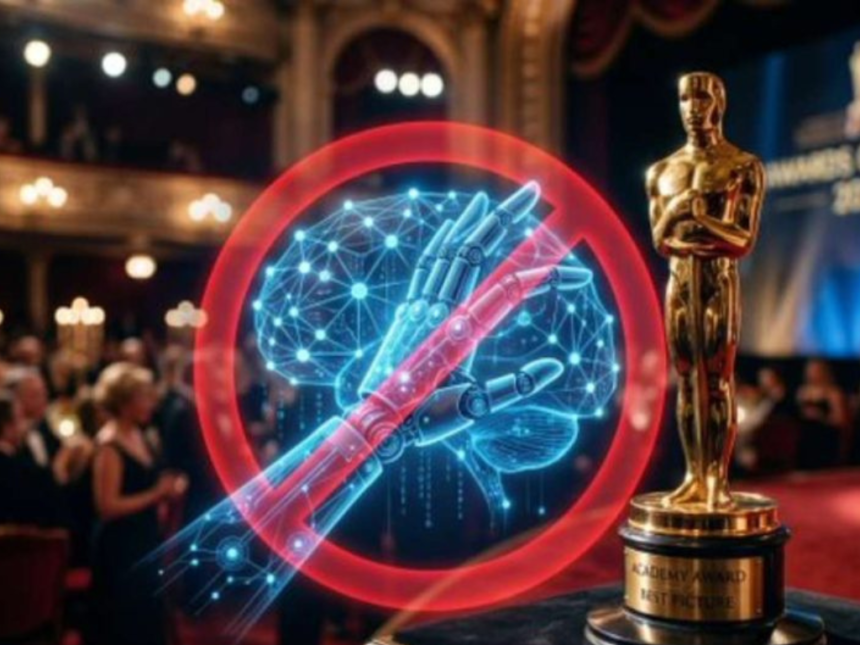
Oscars Draw a Clear Line: Only Human Acting and Writing Eligible for Awards
The Academy of Motion Picture Arts and Sciences has introduced a significant rule change, making it explicit that only human-created performances and screenwriting will be eligible for Oscar recognition. As artificial intelligence continues to expand its role in filmmaking, the Academy is moving to protect what it sees as the core of cinematic creativity: human authorship.
Under the updated eligibility guidelines, acting must be “demonstrably performed by humans,” while scripts must be entirely human-written to qualify for nominations. The Academy described this as a “substantive” update—one that reflects the rapidly evolving relationship between technology and storytelling in Hollywood.
This clarification comes at a time when AI tools are becoming increasingly sophisticated and widely used. In recent months, filmmakers and creators have experimented with AI-generated actors and scripts, raising questions about authenticity and authorship. One striking example involves Val Kilmer, who, after his death in 2025, is reportedly being recreated using AI technology for a leading role in an upcoming film. Similarly, London-based comedian Eline van der Velden revealed she had built a fully artificial AI actor designed to rise to global fame.
The issue of AI in creative industries has already sparked major conflict. During the 2023 writers’ strike led by the Writers Guild of America, one of the central concerns was the potential for studios to use AI to generate scripts, potentially undermining human writers.
At the heart of these concerns are large language models—AI systems trained on vast amounts of human-created text, images, and video. These tools can generate content that mimics human creativity, but they also raise legal and ethical questions. Multiple lawsuits have been filed by actors, authors, and studios alleging copyright infringement by AI companies.
Despite the stricter stance on acting and writing, the Academy stopped short of banning AI outright. Filmmakers are still free to use AI tools in other aspects of production. According to the new rules, such tools “neither help nor harm” a film’s chances of receiving a nomination. Instead, voters will evaluate how central human creativity was to the final work.
“The Academy and each branch will judge the achievement, taking into account the degree to which a human was at the heart of the creative authorship,” the organization stated. It also reserves the right to request further information if questions arise about how AI was used in a project.
Technology has long been embedded in filmmaking. Since the 1990s, computer-generated imagery (CGI) has played a major role in bringing cinematic visions to life. However, CGI is typically crafted and refined by human artists, whereas modern AI tools can generate content with minimal human input—often from simple prompts.
With this rule change, the Academy is drawing a boundary: innovation is welcome, but not at the expense of human creativity. As AI continues to reshape the film industry, the Oscars are signaling that, at least for now, the spotlight still belongs to people.