





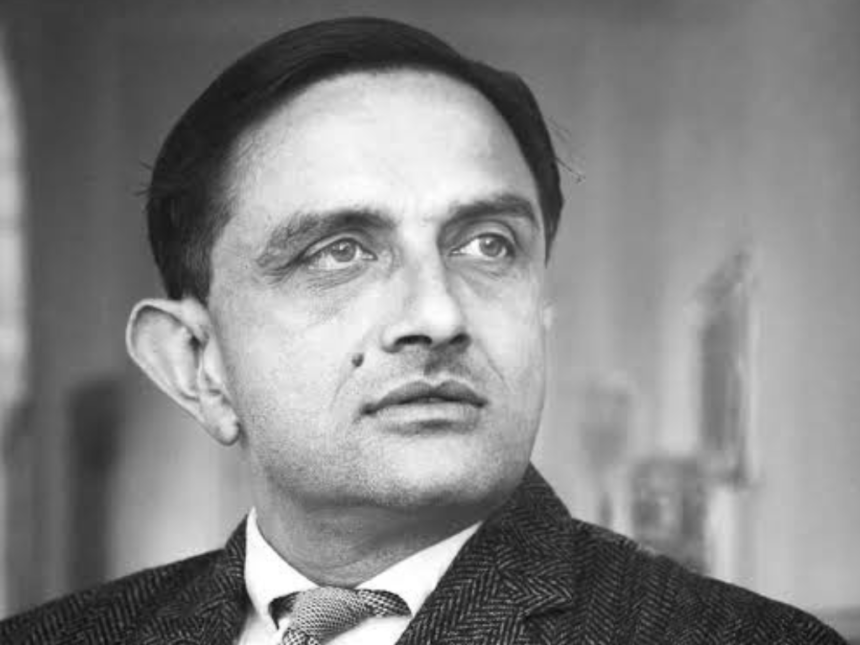
India is remembering Dr. Vikram Sarabhai on his 107th birth anniversary, celebrating the life and legacy of the visionary physicist who laid the foundation of the country’s space programme.
Born on August 12, 1919, in Ahmedabad, Sarabhai was far more than a scientist. He was a visionary who believed that advanced science and technology could play a major role in improving the lives of ordinary Indians. His ideas eventually helped shape the institution that would become the Indian Space Research Organisation (ISRO).
The man behind India’s space journey
At a time when India was still a young nation, Sarabhai recognised the enormous potential of space technology. He believed India did not need to copy the space programmes of developed countries. Instead, he wanted the country to use space science to address its own challenges.
His vision focused on practical applications such as communication, education, weather forecasting and remote sensing. This approach became one of the defining principles of India’s space programme.
From cosmic rays to space research
Sarabhai’s scientific journey began with a deep interest in physics. He studied at the University of Cambridge and later worked on cosmic rays and atmospheric physics.
After returning to India, he established the Physical Research Laboratory (PRL) in Ahmedabad in 1947. The institution became an important centre for scientific research and played a major role in developing India’s scientific community.
His interest soon expanded beyond academic research. Sarabhai understood that India needed strong scientific institutions if it wanted to become technologically independent.
Building India’s space programme
One of Sarabhai’s greatest contributions was his role in establishing India’s organised space research efforts.
He helped establish the Indian National Committee for Space Research (INCOSPAR) in 1962. The organisation later evolved into ISRO in 1969.
Under his leadership, India began developing the foundations of a space programme despite having limited resources.
The famous Thumba Equatorial Rocket Launching Station in Kerala became an important early centre for India’s space research. Sarabhai and his team worked towards developing India’s capabilities in sounding rockets and space science.
His biggest dream: using space for society
Sarabhai’s vision was remarkably forward-looking.
He believed that India’s space programme should not simply be about launching rockets or competing with other nations. Space technology, in his view, had to serve society.
He famously championed the idea that a developing country could benefit enormously from satellites for communication, education and development.
This philosophy later became visible through India’s satellite programmes, remote-sensing capabilities and communication networks.
More than a space scientist
Sarabhai’s contribution was not limited to space science.
He played an important role in building institutions across different fields of science, education and industry. He was associated with institutions including the Indian Institute of Management Ahmedabad (IIMA) and helped establish organisations that contributed to India’s scientific, managerial and technological development.
His work reflected a belief that India’s progress required strong institutions and talented young people.
A legacy that continues beyond Earth
Dr. Sarabhai died on December 30, 1971, at the age of 52. Although his life was relatively short, the institutions and ideas he helped create continued to grow after his death.
Decades later, India has become a major spacefaring nation, carrying out satellite missions, planetary exploration and ambitious human-spaceflight programmes.
From the early rocket launches at Thumba to missions exploring the Moon and Mars, India’s remarkable space journey carries the imprint of Sarabhai’s original vision.
Why Sarabhai still matters
Dr. Vikram Sarabhai’s greatest achievement may not have been a single scientific discovery. It was his ability to imagine what India could become and create institutions capable of turning that vision into reality.
He showed that science could be both ambitious and socially relevant. His belief that technology should improve people’s lives remains central to the philosophy of India’s space programme.
On his 107th birth anniversary, Sarabhai is remembered not simply as the father of the Indian space programme, but as one of the architects of modern Indian science.
His legacy lives on every time an Indian satellite reaches orbit, a weather forecast helps save lives, a remote village receives communication services, or an Indian spacecraft travels beyond Earth.