



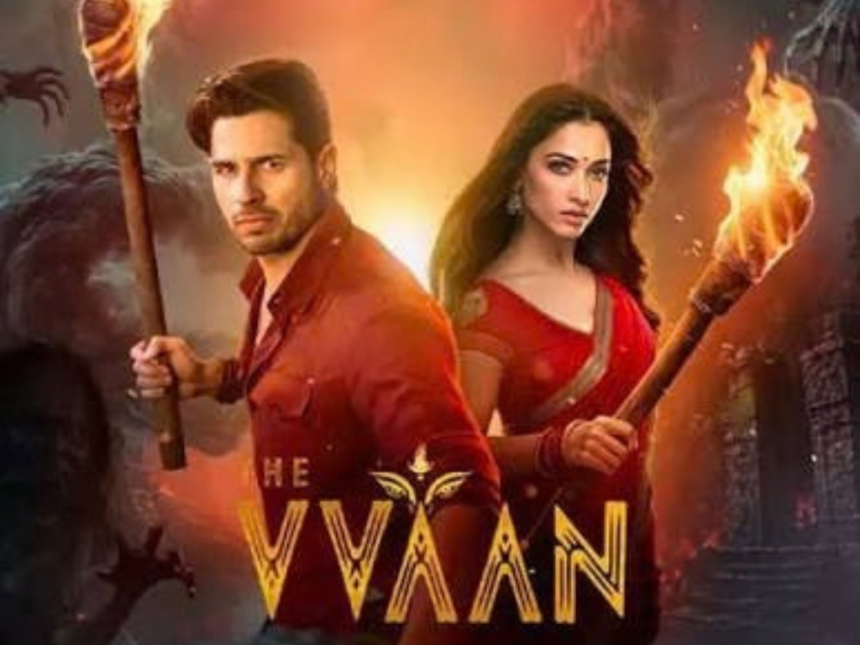
Siddharth Malhotra and Tamannaah Bhatia’s VVAAN attempts to bring horror, fantasy, comedy, romance and Indian mythology together in one film. On paper, the combination sounds interesting. The movie brings together Siddharth Malhotra and Tamannaah Bhatia with the unusual creative collaboration of Ekta Kapoor and the TVF team, known for grounded shows such as Panchayat.
The result is a film that has an interesting idea at its centre but struggles to maintain the same impact throughout. There are some good moments, especially in the first half, but the uneven second half, excessive comedy and several distracting elements make the overall experience less satisfying.
What Is VVAAN About?
The story revolves around Rishi, played by Siddharth Malhotra, who lives in Mumbai with his wife Mamta, played by Tamannaah Bhatia. The couple has been trying to start a family for a long time but has been unable to do so.
Rishi’s elder brother and sister-in-law, played by Anup Soni and Shweta Tiwari, encourage the couple to return to their hometown. Rishi has been avoiding the idea, but financial pressure eventually forces him to go back.
He returns to complete a business deal involving land that is connected to a proposed road project cutting through a forest. However, the project does not go down well with the local villagers, who consider the forest sacred and oppose disturbing the land.
Rishi remains determined to complete the deal, but his decision sets a supernatural chain of events into motion.
The First Half Builds Curiosity
Directed by Deepak Kumar Mishra, VVAAN makes fairly good use of its first half.
The film slowly reveals layers of Rishi’s past while introducing the supernatural elements. The transition from Mumbai to the more rooted world of the valley also feels natural.
The mysterious forest and the questions surrounding the place create curiosity. The audience wants to know what exactly is happening, why people are afraid of entering the forest at night and what lies behind the supernatural story.
The fact that the film draws inspiration from Indian folklore and mythology also gives the first half a sense of freshness.
The Second Half Becomes Uneven
Unfortunately, the film begins losing its grip after the interval.
The editing does little to hold the different elements together, and the story starts becoming noisy rather than engaging. Some characters appear to be included mainly for comic relief, but several of their scenes feel stretched.
The comedy works in a few places, particularly when the characters get strong one-liners, but the comic timing is not consistent throughout the film.
Instead of allowing the supernatural story to build tension, the film often moves between comedy, drama and fantasy without maintaining a steady rhythm.
The climax is also quite loud without being equally engaging. By the time the film reaches its final act, it has introduced more questions than answers, while some of the backstory and revelations do not have the impact they should.
Too Many Songs and Average VFX
Another issue is the number of songs. Several songs appear to interrupt the flow of the story rather than helping the plot move forward.
The visual effects are also fairly average. For a film that depends heavily on fantasy and supernatural elements, stronger VFX could have made the world much more convincing.
Siddharth Malhotra and Tamannaah Bhatia’s Performances
Siddharth Malhotra is watchable throughout the film and performs his role sincerely. However, the character does not feel particularly new, as he is essentially playing another version of the urban man audiences have seen him portray before.
Tamannaah Bhatia, on the other hand, brings an emotional quality to the film. Her character’s journey, especially her desire to become a mother, gives the story some of its more heartfelt moments.
Anup Soni and Shweta Tiwari add credibility to their respective roles, while Sunil Grover is another interesting casting choice.
VVAAN Had a Much Stronger Idea
There was genuine potential in making a fantasy horror story around an Indian goddess, sacred land and local mythology. This could have given VVAAN a unique identity rooted strongly in Indian culture.
Instead, the film sometimes gets distracted by everything surrounding its central idea. The comedy, songs, supernatural elements and family drama all fight for space, and the main story gets lost along the way.
By the end, VVAAN feels like a film with a much more interesting concept than what its final execution manages to deliver.
The performances, especially from Siddharth Malhotra and Tamannaah Bhatia, keep the film watchable, and the first half creates genuine curiosity. But the weak second half, average VFX, unnecessary songs and uneven comedy prevent the film from reaching its full potential.
Now, the real test will be the audience response and box-office performance. It remains to be seen whether VVAAN manages to find its audience and turn its unique mythology-based concept into a successful theatrical run.