





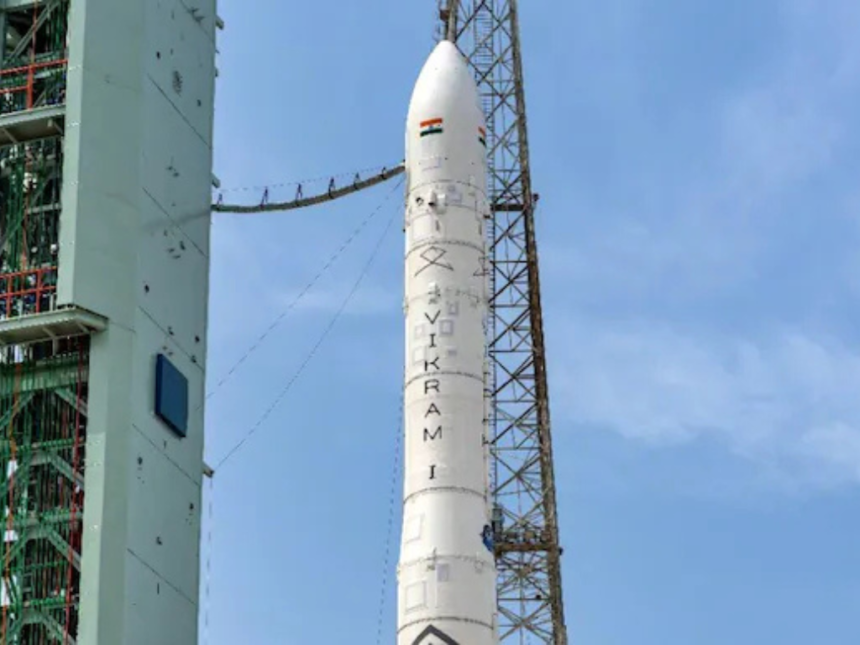
India has taken a giant leap in its space journey with the successful launch of Vikram-1, the country’s first privately developed orbital rocket. Developed by Skyroot Aerospace, the rocket lifted off from the Satish Dhawan Space Centre in Sriharikota under Mission Aagaman, marking a historic moment for India’s growing private space industry.
The successful mission is being hailed as a major milestone, as Vikram-1 flawlessly placed multiple Indian and international customer payloads into a 450-kilometre Low Earth Orbit (LEO) during its maiden orbital flight.
Standing 22 metres tall, roughly the height of a seven-storey building, Vikram-1 represents years of innovation and engineering by the Hyderabad-based space startup. The rocket features an advanced all-carbon composite structure, making it lighter and more efficient than conventional launch vehicles. It is powered by solid-fuel stages and an advanced 3D-printed liquid engine, showcasing cutting-edge technology developed within India’s private space ecosystem.
Designed to carry payloads of up to 350 kilograms to Low Earth Orbit, Vikram-1 aims to provide cost-effective and reliable launch services for satellites, catering to both domestic and international customers. As demand for small satellite launches continues to grow worldwide, the rocket is expected to play a significant role in the commercial space market.
The achievement is significant not only for Skyroot Aerospace but also for India’s space ambitions. With the successful orbital launch of a privately built rocket, India has become only the third country in the world—after the United States and China—to achieve this feat.
The launch also highlights the rapid transformation of India’s space sector since the government opened the industry to private participation. Startups like Skyroot Aerospace have emerged as key contributors to innovation, complementing the work of ISRO while expanding India’s presence in the global space economy.
Mission Aagaman symbolizes the beginning of a new chapter where Indian private companies are no longer just supporting the nation’s space programme but are now leading missions capable of competing on the global stage.
The successful launch of Vikram-1 is expected to attract greater international confidence in India’s commercial launch capabilities, encourage further investment in space technology, and inspire a new generation of scientists, engineers, and entrepreneurs.
As Vikram-1 completes its historic mission, India has once again demonstrated that its journey into space is evolving rapidly—driven not only by government agencies but also by the innovation and ambition of its private sector.