




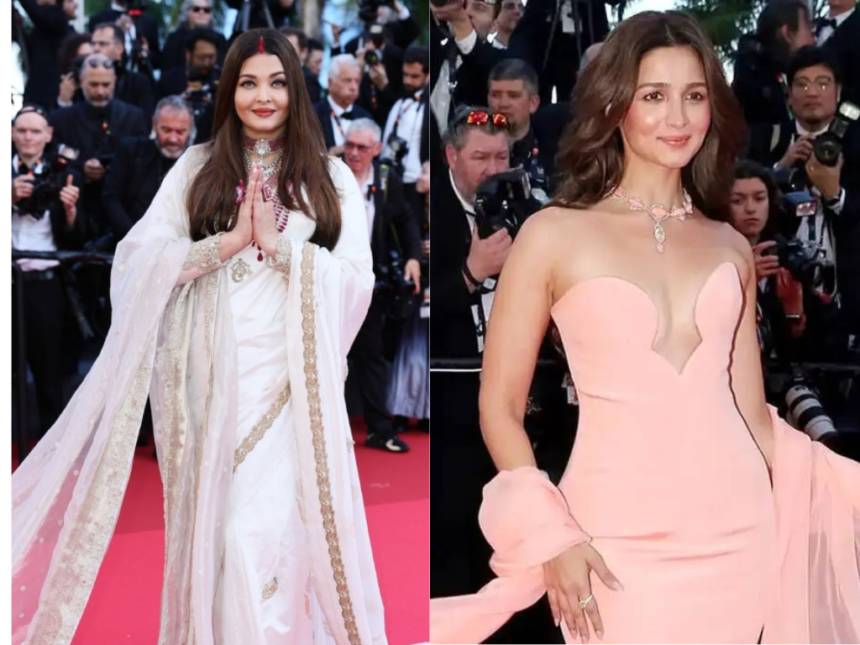
The conversation around the Cannes Film Festival this year went far beyond red carpet fashion or celebrity appearances. It turned into one of the most debated celebrity-brand controversies involving Aishwarya Rai Bachchan and Alia Bhatt after campaign visuals by L’Oréal Paris triggered widespread online discussion about “replacement,” “legacy,” and “new generation representation.”
What started as a simple observation about promotional posters quickly turned into a full-blown internet debate. Fans noticed that Alia Bhatt was being featured prominently in Cannes-related visuals, while Aishwarya Rai Bachchan long considered the face of L’Oréal at Cannes appeared less dominant in some campaign placements. Within hours, social media platforms exploded with emotional reactions, comparisons and theories suggesting that Alia was being positioned as a replacement.
But to understand why this became such a massive controversy, it is important to understand Aishwarya Rai Bachchan’s deep association with both Cannes and L’Oréal.
For more than two decades, Aishwarya has been one of the most recognizable Indian faces at Cannes. Her presence is not just annual; it is cultural. Over time, she became strongly associated with the identity of Indian glamour at Cannes itself. Her appearances often dominate global headlines, and for many fans, she represents the “gold standard” of Cannes fashion. This emotional association is what made the 2026 campaign shift feel so sensitive to audiences.
So when Alia Bhatt appeared more prominently in brand visuals, fans immediately interpreted it through an emotional lens rather than a commercial one.
However, industry observers argue that what happened may not be a replacement at all, but a classic example of modern celebrity marketing strategy.
Inside global branding, companies like L’Oréal Paris operate with multiple ambassadors across different markets and age groups. In India’s case, the brand currently works with multiple high-profile faces including Aishwarya Rai Bachchan, Alia Bhatt and Aditi Rao Hydari. Each ambassador serves a different branding function legacy, youth appeal, luxury positioning, and digital engagement.
From a purely marketing perspective, it is not unusual for brands to highlight different ambassadors in different campaign cycles. However, what made Cannes 2026 different was timing, placement, and emotional history.
This is where the “marketing strategy” theory begins.
Many analysts and social media users believe that L’Oréal may have intentionally or indirectly allowed a narrative gap to form by positioning Alia Bhatt more visibly in certain Cannes campaigns at a time when Aishwarya Rai Bachchan’s presence was less dominant in those specific visuals. This created a contrast that audiences immediately picked up on.
And once that contrast existed, the internet did the rest.
Within hours:
- hashtags comparing Aishwarya and Alia started trending,
- fan communities split into defensive and supportive camps,
- media outlets began publishing “replacement” narratives,
- and engagement around L’Oréal Cannes content increased dramatically.
Importantly, the brand did not need to officially announce anything. The controversy grew organically through audience interpretation.
This is where the idea of “threat marketing” comes in a strategy where audience emotions are triggered by perceived shifts in power or status. In this case, the perceived shift was between a long-established Cannes icon and a rising global Bollywood face.
The psychological impact of this is significant. When audiences feel that a legacy figure is being replaced, they become emotionally engaged. They defend, debate, compare and share content at a much higher rate than normal advertising generates. Essentially, controversy becomes the engine of visibility.
And that is exactly what happened here.
Whether intentional or accidental, the result was undeniable: L’Oréal became one of the most discussed brands during Cannes 2026 without launching a major traditional campaign. The discussion was driven entirely by audience emotion, fan interpretation and media amplification.
At the same time, the controversy reinforced something very important Aishwarya Rai Bachchan’s legacy is still extremely powerful. The intensity of the reaction itself proves how deeply audiences associate her with Cannes. Even after years of multiple brand ambassadors, her presence still feels irreplaceable to many fans.
On the other side, Alia Bhatt’s presence at Cannes 2026 reflected a very different branding direction. Her fashion appearances were modern, globally styled and heavily amplified on digital platforms. From couture gowns to saree-inspired looks, she delivered one of the most consistent high-fashion runs by an Indian celebrity in recent years. For brands targeting younger global audiences, she represents the evolving face of Indian cinema.
But the controversy shows that when legacy and modernity overlap in a high-visibility space like Cannes, audience emotions can easily turn it into a rivalry narrative even when none officially exists.
Ultimately, whether L’Oréal intentionally designed this reaction or not remains unconfirmed. But what is clear is that the outcome resembles a highly effective viral marketing cycle:
a visual shift,
an emotional audience reaction,
a global debate,
and continuous brand visibility.
And in today’s digital world, that level of attention is often more powerful than traditional advertising. So while fans continue debating whether Alia Bhatt replaced Aishwarya Rai Bachchan or not, the bigger reality might be simpler the internet created the controversy, and the brand benefited from it.