




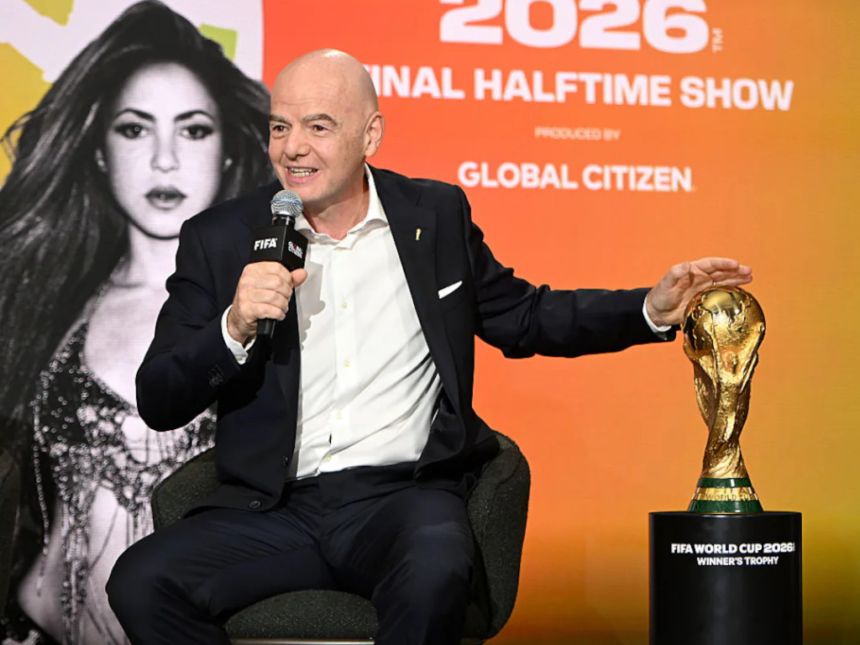
After months of uncertainty and behind-the-scenes negotiations, FIFA is now set to finalise a major broadcasting agreement for the 2026 FIFA World Cup in India. According to sources, the deal is expected to be worth between USD 30–35 million, making it one of the biggest sports broadcasting agreements in the Indian football market in recent years.
The official announcement is expected next week, and for football lovers across the country, it comes as a huge relief.
Because despite India’s growing obsession with global football, there had been increasing uncertainty around whether fans would get seamless access to the biggest World Cup ever organised.
Now, with the deal nearly finalised, Indian audiences are expected to receive complete coverage of the tournament across television and digital platforms.
And this will not be an ordinary World Cup.
The 2026 FIFA World Cup, jointly hosted by the United States, Canada, and Mexico, is set to become the largest edition in football history.
For the first time ever, FIFA has expanded the tournament from 32 teams to 48 teams. That means the number of matches will jump dramatically from 64 to 104 games.
In simple words, fans will get far more football, more knockout drama, more global stars, and nearly an entire month packed with nonstop matches.
And for India, this matters enormously.
Even though the Indian men’s national football team continues to struggle internationally, the country’s appetite for world football has exploded over the past decade.
Today, football in India is no longer a niche sport followed by only a few traditional pockets like Kolkata or Goa. It has become a massive entertainment ecosystem driven by:
- the English Premier League,
- UEFA Champions League,
- La Liga,
- FIFA World Cups,
- fantasy gaming,
- social media football culture,
- and streaming platforms.
Cities such as Kolkata, Goa, Kochi, and Bengaluru remain deeply passionate football centres, but now even metro audiences in Mumbai, Delhi, Hyderabad, Pune, and Chennai are heavily invested in European clubs and international football stars.
Young Indian fans today follow players like they follow movie celebrities.
Whether it is club rivalries, transfer rumours, tactical debates, or late-night Champions League matches, football culture in India has become deeply mainstream among urban youth audiences.
That is exactly why FIFA considers India one of its most important long-term markets despite the national team’s disappointing performances.
And there is irony in that reality.
While Indian audiences passionately support clubs like Real Madrid, Manchester City, Barcelona, Liverpool, and Manchester United, support for Indian domestic football still struggles to reach the same emotional intensity.
The contrast has become one of Indian football’s biggest challenges.
On one side, India delivers massive television ratings for European football and FIFA tournaments. On the other, the country’s own football structure continues facing serious questions around:
- grassroots development,
- governance,
- coaching systems,
- infrastructure,
- and competitive depth.
The Indian national team’s recent performances have only increased those concerns.
After briefly creating excitement with qualification for the AFC Asian Cup, the momentum failed to sustain. India’s FIFA ranking has slipped significantly following poor international results, and criticism of the football ecosystem has grown louder.
Many experts believe India has passionate fans but still lacks a stable football foundation capable of consistently producing elite-level talent.
And yet, commercially, India remains extremely valuable.
Global football organisations understand that India represents one of the largest untapped sports-viewing markets in the world. Even if Indian football itself is struggling competitively, Indian audiences continue consuming international football at extraordinary levels.
That commercial potential is exactly why FIFA, the Premier League, and La Liga continue investing heavily in Indian audiences.
Interestingly, FIFA also appears to be adopting a more flexible commercial strategy across Asian markets ahead of the 2026 tournament.
Reports suggest that China secured its World Cup broadcasting rights at nearly an 80 percent discount compared to previous cycles. This reflects FIFA’s growing understanding that expanding long-term market reach in Asia may be more valuable than demanding extremely aggressive short-term pricing.
Meanwhile, Europe still remains FIFA’s most expensive broadcasting market due to massive football viewership and competition among broadcasters.
For Indian fans, however, the bigger emotion right now is simple excitement.
Because once the deal becomes official, it guarantees access to more than 100 World Cup matches featuring the biggest names in football.
And with the tournament scheduled during the Indian summer, fans are already preparing themselves for sleepless nights, late kick-offs, watch parties, and social media madness.
The 2026 World Cup is expected to dominate conversations globally.
For Indian football fans, it will also become another reminder of a complicated reality:
India may still be searching for its place on football’s biggest stage, but its audience has already become one of the sport’s most powerful markets.