




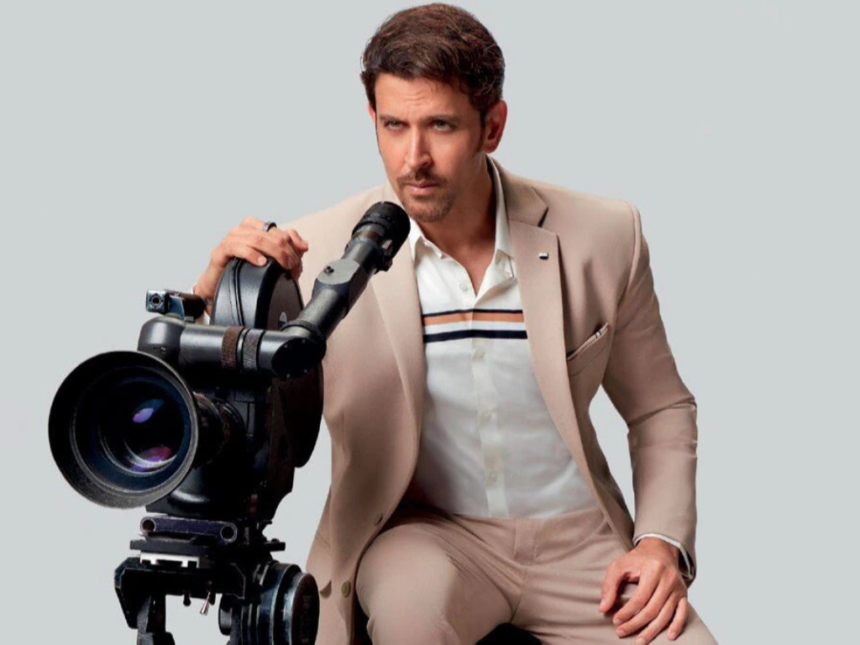
Actor Hrithik Roshan has joined a conversation about how Indian audiences often focus more on stars than the art and people behind a film. The actor recently reacted to a long social media post by filmmaker Pratim D Gupta, who questioned why celebrity sightings attract more attention than the work of acclaimed filmmakers and technicians.
Pratim D Gupta’s post began after Vijay Sethupathi and Sai Pallavi were spotted shooting for a film in Kolkata. While the presence of the actors generated considerable attention, the filmmaker pointed out that another major development was being overlooked — legendary director Mani Ratnam had returned to the city to shoot a film, while three-time National Award-winning cinematographer Avik Mukhopadhyay was also working on the project.
Gupta argued that this reflects a larger cultural obsession with celebrity. He questioned why audiences and the media are often more interested in seeing a star in public than learning about the creative minds responsible for making a film.
According to him, cinema has gradually become associated with celebrity spotting rather than filmmaking itself. He highlighted how actors can attract crowds simply by appearing at a public place, while cinematographers, directors, writers and other technicians often remain unknown despite shaping the movies audiences remember for years.
“Cinema is bigger than stardom,” Gupta concluded, stressing that the industry needs to recognise and celebrate the people who work behind the camera as much as those who appear in front of it.
Hrithik Roshan appeared to strongly agree with the filmmaker’s thoughts. Commenting on the post, the actor wrote, “Cinema is bigger than stardom. Well said.”
Hrithik went on to say that India still has a “very superficial understanding of cinema.” According to the actor, audiences sometimes blur the line between a performer and the character they play, assuming that what a star does on screen represents who they are in real life.
He compared this mindset to the way children perceive fictional characters, suggesting that audiences have not yet fully developed an understanding of the art and craft involved in filmmaking.
The actor also encouraged people to look beyond the celebrity appeal of movies and become more interested in the many other elements that make a film possible. From cinematography and editing to writing, direction, production design and music, Hrithik suggested that there are several aspects of filmmaking that deserve greater attention.
His comments have sparked an interesting conversation about the changing relationship between Bollywood, its stars and audiences. In an industry where celebrity culture has always played a major role, the discussion raises an important question: are viewers becoming more interested in the people selling the film than in the people actually creating it?
Hrithik himself has been one of Bollywood’s biggest stars for more than two decades, making his comments particularly noteworthy. Despite being one of the industry’s most recognisable faces, the actor used the discussion to emphasise that filmmaking is a collaborative art and cannot be reduced to the popularity of its stars.
The conversation also highlights the importance of recognising technicians whose contributions may not always be visible to audiences. A powerful image, memorable background score, gripping screenplay or carefully designed sequence can become an unforgettable part of a film, even when viewers may not know who created it.
With his response, Hrithik has added his voice to the argument that cinema should be celebrated as an art form rather than simply as a vehicle for celebrity culture. His message is simple: stars may bring audiences into theatres, but directors, writers, cinematographers, editors, composers and countless other artists are the ones who ultimately create the cinematic experience.