

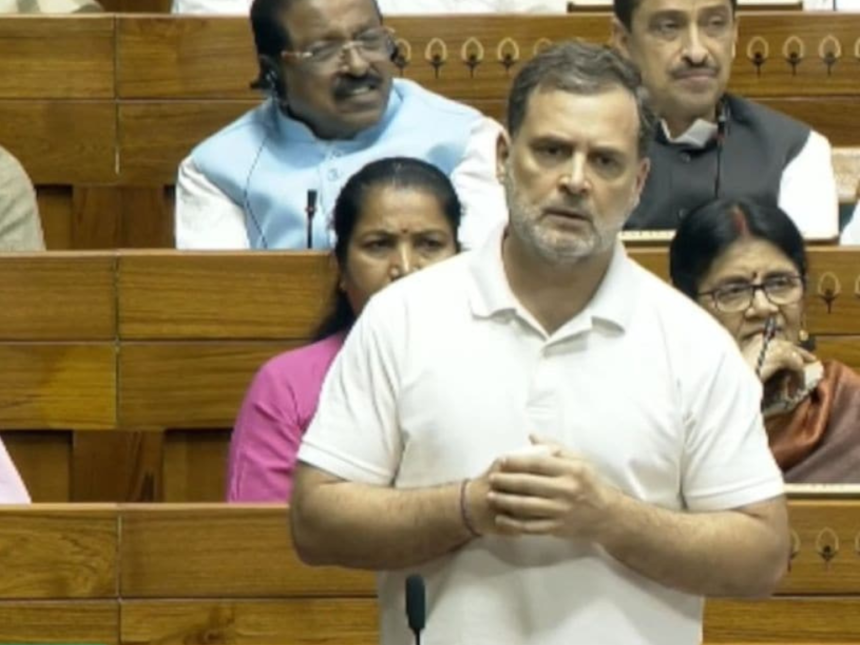
A sharp political confrontation unfolded in Parliament as Rahul Gandhi launched a strong attack on the Centre over its approach to implementing women’s reservation, linking it to the contentious issue of delimitation. Speaking during a special parliamentary session, the Congress leader described the government’s move as a “panic reaction” and accused it of attempting to reshape India’s electoral map under the guise of women’s empowerment.
At the heart of the debate is the proposal to implement 33% reservation for women in Parliament and state assemblies. While the Women’s Reservation Bill had already been passed in 2023 with broad political consensus, Gandhi argued that the current move to tie it with delimitation and expansion of the Lok Sabha raises serious concerns. According to him, this linkage is not about empowering women but about recalibrating political representation in a way that could benefit the ruling party.
Gandhi alleged that the government’s strategy could disadvantage southern, northeastern, and smaller states that have successfully controlled population growth. Since delimitation would rely on population data—primarily from the 2011 census—states with higher population growth, many of them in northern India, could gain a larger share of parliamentary seats. This, he suggested, risks skewing the balance of political power.
Calling the move “nothing short of anti-national,” Gandhi said the opposition would resist any attempt to reduce representation for certain regions. He also accused the government of being reluctant to share power with marginalized communities, particularly Other Backward Classes (OBCs), claiming that such steps are driven by electoral calculations rather than inclusive governance.
The Centre, led by Prime Minister Narendra Modi, has firmly rejected these allegations. The government maintains that delimitation and expansion of the Lok Sabha are necessary steps to operationalize the women’s quota effectively before the 2029 general elections. It has also accused opposition parties of politicizing an issue of women’s empowerment for their own benefit.
Prime Minister Modi has assured Parliament that no state will face injustice due to the proposed changes, offering a “guarantee” that representation will remain fair across regions. However, skepticism persists among opposition leaders and several regional parties.
Leaders from southern states, including M. K. Stalin, have voiced strong opposition, warning that the exercise could reduce their political influence despite their progress in population control and development indicators. Congress MP Shashi Tharoor echoed similar concerns, suggesting that the government is using women’s reservation as a pretext to push through broader electoral changes.
The proposal to expand the Lok Sabha to around 850 seats has added another layer to the controversy. Critics question the necessity of such a large increase, arguing that women’s reservation could be implemented within the current framework without redrawing constituencies or significantly increasing the number of seats.
As the debate intensifies, the issue has evolved beyond women’s representation into a larger political battle over federal balance, electoral fairness, and the future shape of India’s democracy. With the 2029 general elections in view, the outcome of this standoff could have far-reaching implications for the country’s political landscape.