




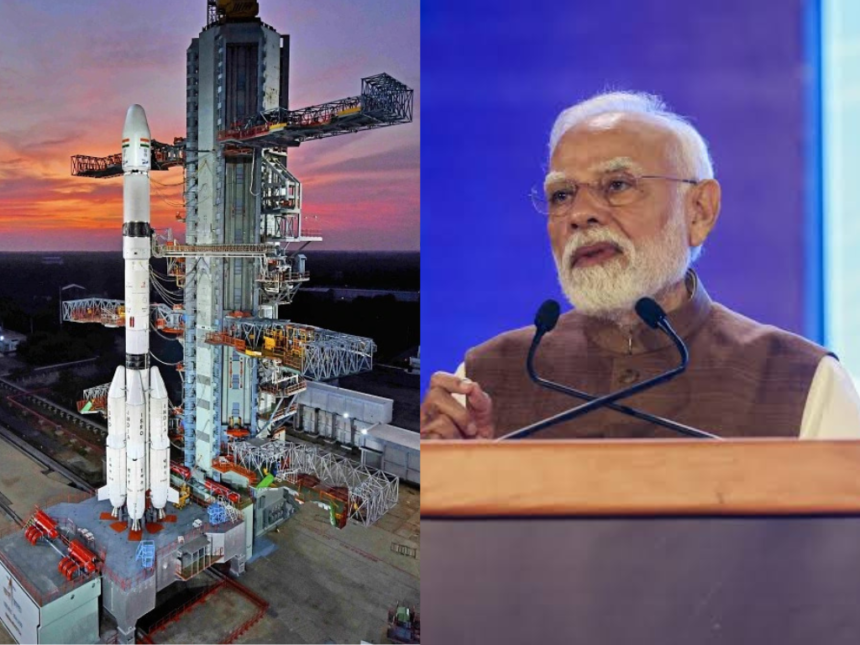
The Indian Space Research Organisation (ISRO) has achieved another significant milestone in India’s space programme with the successful launch of the NVS-03 navigation satellite. Prime Minister Narendra Modi congratulated ISRO scientists and engineers on the achievement, highlighting the mission’s role in strengthening India’s self-reliance in critical space and navigation technologies.
The satellite was launched aboard the Geosynchronous Satellite Launch Vehicle (GSLV-F18) from the Second Launch Pad at the Satish Dhawan Space Centre in Sriharikota, Andhra Pradesh, at 11:51 pm IST on October 30, 2026. The 2,232-kg satellite was successfully placed into its intended Geosynchronous Transfer Orbit (GTO).
PM Modi Praises ISRO’s Achievement
Reacting to the successful mission on October 31, Prime Minister Modi praised the dedication and technical expertise of ISRO’s scientists and engineers. He said that NVS-03, with its enhanced capabilities, would further India’s pursuit of self-reliance in critical technologies and support navigation services that benefit people across the country.
The Prime Minister also noted that the continued efforts and ingenuity of India’s space scientists were making the nation proud.
Also Read :- https://x.com/narendramodi/status/2116341951243166081?s=20
How NVS-03 Will Strengthen India’s NavIC System
NVS-03 is the third satellite in the second-generation NVS series, developed to strengthen Navigation with Indian Constellation (NavIC), India’s independent regional satellite navigation system. The network provides positioning, navigation and timing services across India and up to approximately 1,500 kilometres beyond its geographical boundaries.
The new satellite carries an indigenous atomic clock, along with additional procured atomic clocks, to support accurate Position, Velocity and Timing (PVT) calculations. It also introduces the civilian L1 navigation signal alongside the existing L5 and S-band signals. This is expected to improve compatibility with consumer navigation devices and smartphones.
The satellite’s launch is particularly important for India’s effort to strengthen its own navigation infrastructure and reduce dependence on foreign satellite navigation systems.
What Happens After the Launch?
After being injected into Geosynchronous Transfer Orbit, NVS-03 will undergo a series of orbit-raising manoeuvres using its onboard liquid propulsion system. These manoeuvres are intended to place it in its designated geosynchronous position at 32.5 degrees East.
ISRO confirmed that the satellite’s solar arrays deployed successfully after launch and that its initial health parameters were normal. The successful deployment marks an important step towards strengthening the NavIC constellation.
The mission is the 20th flight of the GSLV launch vehicle and ISRO’s third space launch of 2026. With the planned launches of NVS-04 and NVS-05, India aims to further expand its second-generation navigation satellite network.
The successful launch of NVS-03 is another step towards building a stronger, more reliable and independent navigation system, supporting applications that depend on accurate positioning and timing across the country.