




Sonakshi Sinha and Zaheer Iqbal’s Tu Hai Meri Kiran brings an unusual time-travel concept to the screen, blending romance, obsession and suspense into a story that promises plenty of twists. Directed by Karan Rawal, the film begins with an intriguing premise that immediately sparks curiosity. However, as the narrative progresses, its complicated timeline and increasingly ambitious twists make it difficult to maintain the same level of excitement throughout.
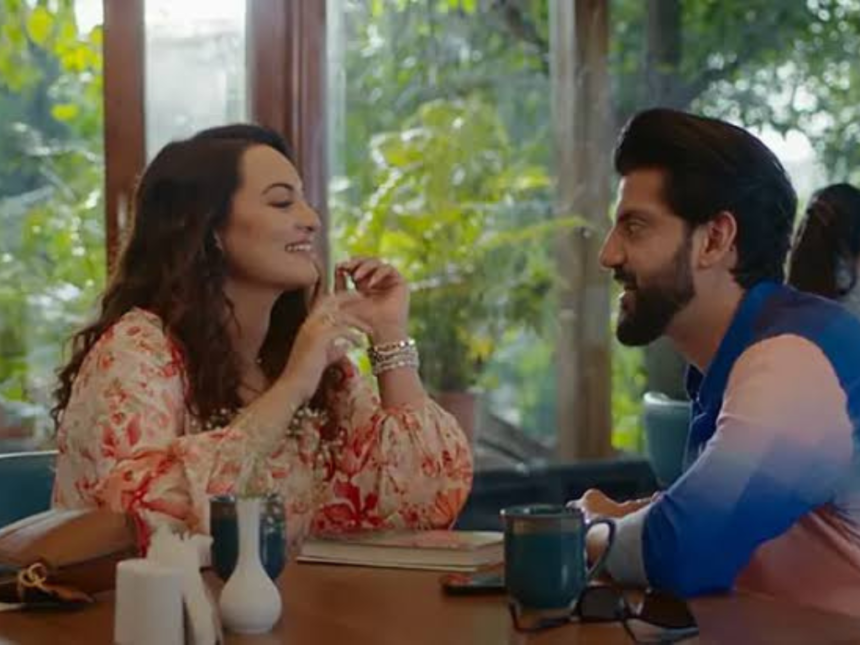
The film revolves around Kiran, played by Sonakshi Sinha, a popular author who appears to be living a happy married life with her husband, Riyaan, portrayed by Ankit Gupta. Her life takes an unexpected turn when she discovers an old phone that connects her to another phone from the past, dating back to 2016. Through this mysterious connection, she comes into contact with Samar, played by Zaheer Iqbal, who lives ten years earlier.
What begins as an unusual communication between two people separated by time soon turns into something far more disturbing. Samar becomes obsessed with Kiran and decides to change the past in an attempt to become part of her life. His actions set off a chain of events that threaten to disrupt Kiran’s present and alter the course of several lives.
An intriguing time-travel concept that grabs attention
One of the biggest strengths of Tu Hai Meri Kiran is its central idea. The possibility of connecting with someone from the past through an old phone creates an interesting foundation for a story about fate, relationships and the consequences of changing history.
The first half focuses on Kiran and Samar discovering the strange connection between their phones and understanding the possibilities it offers. The mystery surrounding their communication keeps the story engaging, while the ten-year gap between their timelines adds another layer of intrigue.
Time-travel films often invite comparisons with popular Hollywood franchises, including the Avengers films. However, Tu Hai Meri Kiran approaches the concept through the lens of a Hindi commercial entertainer, combining the science-fiction element with emotional conflict, romance and obsession.
The film also takes certain cinematic liberties with its time-travel mechanics. While viewers may be willing to accept some creative freedom in a story of this kind, the screenplay still needs to establish clear rules so that the audience can follow what is happening.
Unfortunately, this is where the film begins to struggle.
The screenplay becomes increasingly complicated in the second half
The main problem with Tu Hai Meri Kiran is not its ambitious premise but the way the story handles its twists. As the film moves between 2016 and 2026, the narrative becomes increasingly complicated, requiring viewers to pay close attention to the connections between the two timelines.
The second half attempts to explain the developments while continuing to introduce new complications. Although this approach initially helps sustain curiosity, the overlapping realities eventually make the story difficult to follow.
At several points, the screenplay appears more interested in surprising the audience than in allowing its central conflict to develop naturally. As a result, some twists create confusion rather than delivering the emotional or dramatic impact the filmmakers appear to be aiming for.
Director Karan Rawal, who has also written the film, deserves credit for attempting something different. However, the ambition of the concept becomes a disadvantage when the storytelling struggles to keep pace with the ideas being introduced.
The climax is another area where the film could have benefited from a more focused approach. Rather than bringing the various threads together in a satisfying manner, the narrative stretches its ideas for longer than necessary. A tighter screenplay could have made the final act more effective and helped the film leave a stronger impression.
Sonakshi Sinha delivers a good performance
Sonakshi Sinha gives a good performance as Kiran, the woman whose seemingly stable life is thrown into uncertainty by an extraordinary discovery. She carries the character’s emotional journey with conviction, particularly as the mystery surrounding the phone begins to affect her present.
Kiran’s situation requires her to navigate confusion, fear and the consequences of events that appear to be beyond her control. Sonakshi brings enough emotional weight to the role to keep the character engaging, even when the screenplay becomes difficult to follow.
Zaheer Iqbal, meanwhile, makes for an interesting antagonist as Samar. His character’s obsession with Kiran provides much of the film’s tension, turning what could have been a fascinating connection across time into something increasingly unsettling.
Zaheer brings an intriguing presence to the role, and his scenes with Sonakshi help maintain the film’s central conflict. The two actors form a decent team and manage to keep the story moving even when the writing loses some of its clarity.
Ankit Gupta also plays an important part in the story as Riyaan, Kiran’s husband, whose place in her life becomes relevant as the timelines begin to overlap.
Final verdict: A fresh idea let down by complicated writing
Tu Hai Meri Kiran has the ingredients for an engaging time-travel thriller. Its unusual premise, the mystery of the connected phones and the conflict between Kiran’s present and Samar’s past provide a strong starting point. Sonakshi Sinha and Zaheer Iqbal also deliver performances that help the film remain watchable.
However, the screenplay becomes so occupied with its twists and overlapping realities that the story gradually loses its direction. The second half demands considerable attention from viewers, but the explanations and revelations do not always provide a satisfying payoff.
Ultimately, the film’s biggest weakness is not the idea of time travel itself, but the execution of that idea. With a more carefully structured screenplay, a tighter climax and clearer storytelling, Tu Hai Meri Kiran could have made much better use of its promising concept.
Verdict: Tu Hai Meri Kiran offers an interesting premise and decent performances, but its confusing timelines and overcomplicated writing prevent it from reaching its full potential.